
로그인 선택
미리보기
커뮤니티

 23.06.15
글 등록
DEVOTEE를 활성화 시키면
지금 작성한 커뮤니티 글에 대해 1개의 댓글을 달아줍니다.
버튼을 누르면 글 수정 시 ChatGPT가 작성한 댓글이 수정됩니다.
임시저장함
최대 20건까지 저장합니다.
| 컨텐츠 유형 | 제목 | 저장일 | 삭제 |
|---|

본인인증
고객님의 소중한 개인정보보호를 위해
본인인증을 진행해주세요. 본인인증 미 진행 시 로그인이 제한됩니다.
본인인증 로그인에 실패하였습니다.
회원이 아니시거나 본인인증 등록이
완료되지 않은 사용자입니다.
회원정보 연결
OpenLab - LLMOps : Ragas Getting Started

- DEVOTEE 요약
- 이 튜토리얼에서는 RAG 파이프라인 평가를 위한 합성 평가 데이터 세트의 생성 과정 및 평가 방법을 소개합니다. 이 과정에서 파이썬 가상환경 설정, OpenAI 모델을 활용한 합성 데이터셋 생성 및 평가, Faiss를 이용한 벡터 데이터베이스 인덱싱 및 벡터화, 그리고 합성 데이터셋을 이용한 RAG 파이프라인 평가를 위해 Ragas 도구를 사용합니다. 마지막으로 생성된 데이터 세트에 대한 평가를 실행하고, 'faithfulness', 'answer_relevancy' 등의 메트릭을 사용하여 평가 결과를 확인합니다.
Installation
파이썬 가상환경에서 pipenv 도구를 통해 파이썬 패키지를 설치합니다.
pipenv install!cat ../PipfileGenerate a Synthetic Test Set
이 튜토리얼에서는 RAG 파이프라인을 평가하기 위한 합성 평가 데이터 세트를 만드는 방법을 안내합니다.
이를 위해 OpenAI 모델을 활용합니다. 사용자 환경 내에서 OpenAI API 키를 환경변수로 입력합니다.
아래 코드의 경우 .env 파일에 OPENAI_API_KEY= 설정하고, load_dotenv 함수를 이용하여 환경변수를 한번에 로딩했습니다.
from dotenv import load_dotenv
import os

load_dotenv(verbose=True)

# Create your own .env file in root path and add OPENAI_API_KEY
os.environ['OPENAI_API_KEY'] = os.getenv("OPENAI_API_KEY")
Load Documents & Vector Store (/w Faiss)
처음 합성 데이터셋에 Question/Contexts/Ground_Truth 샘플을 생성하기 위해서는 망뭉치가 필요합니다.
이를 위해 LangChain WebBaseLoader 를 사용해서 https://blog.langchain.dev/langchain-v0-1-0/ 웹문서를 로드합니다.
이후 웹문서 말뭉치를 청크 단위로 자르고, 이 청크를 워드 임베딩 모델 (text-embedding-ada-002) 이용하여 벡터화하여 Faiss 벡터 데이터베이스에 인덱싱 합니다.
FAISS.from_documents() 함수를 통해 워드 임베딩하고, 메모리에 저장된 벡터 값들을 파일로 저장하여 이후 다시 메모리에 리로딩하여 재사용할 수 있도록 합니다.
from langchain_community.document_loaders import WebBaseLoader
from langchain_text_splitters import RecursiveCharacterTextSplitter
from langchain_openai import OpenAIEmbeddings
from langchain_community.vectorstores import FAISS
import os

embeddings = OpenAIEmbeddings(model="text-embedding-ada-002")

loader = WebBaseLoader(
    "https://blog.langchain.dev/langchain-v0-1-0/"
)
documents = loader.load()

for document in documents:
    document.metadata['filename'] = document.metadata['source']


# save & load data
vdb_path = "db/faiss/langchain_docs"
if(os.path.exists(vdb_path)):
    print(f'load faiss {vdb_path}')
    vector_store = FAISS.load_local(vdb_path, embeddings, allow_dangerous_deserialization=True)
else:
    text_splitter = RecursiveCharacterTextSplitter(
        chunk_size = 1250,
        chunk_overlap = 100,
        length_function = len,
        is_separator_regex = False
    )
    split_docs = text_splitter.split_documents(documents)

    vector_store = FAISS.from_documents(split_docs, embeddings)
    vector_store.save_local(vdb_path)
load faiss db/faiss/langchain_docsRAG Chain with LCEL(LangChain Expression Language)
Ragas 이용하여 합성 데이터셋 (Question/Contexts/Ground_Truth)을 자동으로 생성합니다.
합성 데이터셋을 이용하여 RAG 파이프라인을 평가하려면 Question/Contexts 데이터셋을 RAG Chain 으로 실행하여
Answer 값을 생성한후 Ragas Evalation 도구를 이용하여 Ground Truth 값과 비교하여 주요 평가지표 (Metric)로 수치화 합니다.
이를 위한 RAG Chain 기능을 아래와 같이 구현하여 Ragas Evaluation 에 활용합니다.
아래 코드는 RAG Chain 을 이용하여 Faiss에 이미 워드 임베딩한 langchain docs 문서를 기반으로
"What are the major changes in v 0.1.0?" 질문에 대한 Answer 를 생성하는 과정을 테스트하여 검증하는 예제코드입니다.
from operator import itemgetter

from langchain import hub
from langchain_core.runnables import RunnablePassthrough
from langchain_core.output_parsers import StrOutputParser
from langchain_community.chat_models import ChatOpenAI

retriever = vector_store.as_retriever()
prompt = hub.pull("rlm/rag-prompt")
llm = ChatOpenAI(model_name="gpt-3.5-turbo", temperature=0)

def format_docs(args):
    docs = args["source_docs"]
    return "\n\n".join(doc.page_content for doc in docs)

rag_chain = (
    RunnablePassthrough.assign(
        question=itemgetter("question")
    )
    | {
        "source_docs" : itemgetter("question") | retriever,
        "question": itemgetter("question"),
    }
    | {
        "source_docs": itemgetter("source_docs"),
        "answer": {
            "context": format_docs,
            "question": itemgetter("question"),
        } | prompt | llm | StrOutputParser()
    }
)

rag_chain.invoke({"question" : "What are the major changes in v 0.1.0?"})
/Users/1111999/.local/share/virtualenvs/llmops-ESENPtay/lib/python3.11/site-packages/langchain_core/_api/deprecation.py:119: LangChainDeprecationWarning: The class `ChatOpenAI` was deprecated in LangChain 0.0.10 and will be removed in 0.3.0. An updated version of the class exists in the langchain-openai package and should be used instead. To use it run `pip install -U langchain-openai` and import as `from langchain_openai import ChatOpenAI`.
warn_deprecated(
{'source_docs': [Document(page_content='versioning policy for a little over a month now.langchain itself, however, still remained on 0.0.x versions. Having all releases on minor version 0 created a few challenges:Users couldn’t be confident that updating would not have breaking changeslangchain became bloated and unstable as we took a “maintain everything” approach to reduce breaking changes and deprecation notificationsHowever, starting today with the release of langchain 0.1.0, all future releases will follow a new versioning standard. Specifically:Any breaking changes to the public API will result in a minor version bump (the second digit)Any bug fixes or new features will result in a patch version bump (the third digit)We hope that this, combined with the previous architectural changes, will:Communicate clearly if breaking changes are made, allowing developers to update with confidenceGive us an avenue for officially deprecating and deleting old code, reducing bloatMore responsibly deal with integrations (whose SDKs are often changing as rapidly as LangChain)Even after we release a 0.2 version, we will commit to maintaining a branch of 0.1, but will only patch critical bug fixes. See more towards the end of this post on our plans for that.While re-architecting the', metadata={'source': 'https://blog.langchain.dev/langchain-v0-1-0/', 'title': 'LangChain v0.1.0', 'language': 'en', 'filename': 'https://blog.langchain.dev/langchain-v0-1-0/'}, _lc_kwargs={'page_content': 'versioning policy for a little over a month now.langchain itself, however, still remained on 0.0.x versions. Having all releases on minor version 0 created a few challenges:Users couldn’t be confident that updating would not have breaking changeslangchain became bloated and unstable as we took a “maintain everything” approach to reduce breaking changes and deprecation notificationsHowever, starting today with the release of langchain 0.1.0, all future releases will follow a new versioning standard. Specifically:Any breaking changes to the public API will result in a minor version bump (the second digit)Any bug fixes or new features will result in a patch version bump (the third digit)We hope that this, combined with the previous architectural changes, will:Communicate clearly if breaking changes are made, allowing developers to update with confidenceGive us an avenue for officially deprecating and deleting old code, reducing bloatMore responsibly deal with integrations (whose SDKs are often changing as rapidly as LangChain)Even after we release a 0.2 version, we will commit to maintaining a branch of 0.1, but will only patch critical bug fixes. See more towards the end of this post on our plans for that.While re-architecting the', 'metadata': {'source': 'https://blog.langchain.dev/langchain-v0-1-0/', 'title': 'LangChain v0.1.0', 'language': 'en', 'filename': 'https://blog.langchain.dev/langchain-v0-1-0/'}}),
Document(page_content='Today we’re excited to announce the release of langchain 0.1.0, our first stable version. It is fully backwards compatible, comes in both Python and JavaScript, and comes with improved focus through both functionality and documentation. A stable version of LangChain helps us earn developer trust and gives us the ability to evolve the library systematically and safely.Python GitHub DiscussionPython v0.1.0 GuidesJS v0.1.0 GuidesYouTube WalkthroughIntroductionLangChain has been around for a little over a year and has changed a lot as it’s grown to become the default framework for building LLM applications. As we previewed a month ago, we recently decided to make significant changes to the\xa0 LangChain package architecture in order to better organize the project and strengthen the foundation.\xa0Specifically we made two large architectural changes: separating out langchain-core and separating out partner packages (either into langchain-community or standalone partner packages) from langchain.\xa0As a reminder, langchain-core contains the main abstractions, interfaces, and core functionality. This code is stable and has been following a stricter versioning policy for a little over a month now.langchain itself, however, still remained on 0.0.x', metadata={'source': 'https://blog.langchain.dev/langchain-v0-1-0/', 'title': 'LangChain v0.1.0', 'language': 'en', 'filename': 'https://blog.langchain.dev/langchain-v0-1-0/'}, _lc_kwargs={'page_content': 'Today we’re excited to announce the release of langchain 0.1.0, our first stable version. It is fully backwards compatible, comes in both Python and JavaScript, and comes with improved focus through both functionality and documentation. A stable version of LangChain helps us earn developer trust and gives us the ability to evolve the library systematically and safely.Python GitHub DiscussionPython v0.1.0 GuidesJS v0.1.0 GuidesYouTube WalkthroughIntroductionLangChain has been around for a little over a year and has changed a lot as it’s grown to become the default framework for building LLM applications. As we previewed a month ago, we recently decided to make significant changes to the\xa0 LangChain package architecture in order to better organize the project and strengthen the foundation.\xa0Specifically we made two large architectural changes: separating out langchain-core and separating out partner packages (either into langchain-community or standalone partner packages) from langchain.\xa0As a reminder, langchain-core contains the main abstractions, interfaces, and core functionality. This code is stable and has been following a stricter versioning policy for a little over a month now.langchain itself, however, still remained on 0.0.x', 'metadata': {'source': 'https://blog.langchain.dev/langchain-v0-1-0/', 'title': 'LangChain v0.1.0', 'language': 'en', 'filename': 'https://blog.langchain.dev/langchain-v0-1-0/'}}),
Document(page_content="new types of agentsImproving our production ingestion capabilitiesRemoving old and unused functionalityImportantly, even though we are excited about removing some of the old and legacy code to make langchain slimmer and more focused, we also want to maintain support for people who are still using the old version. That is why we will maintain 0.1 as a stable branch (patching in critical bug fixes) for at least 3 months after 0.2 release. We plan to do this for every stable release from here on out.And if you've been wanting to get started contributing, there's never been a better time. We recently added a good getting started issue on GitHub if you're looking for a place to start.One More ThingA large part of LangChain v0.1.0 is stability and focus on the core areas outlined above. Now that we've identified the areas people love about LangChain, we can work on adding more advanced and complete tooling there.One of the main things people love about LangChain is it's support for agents. Most agents are largely defined as running an LLM in some sort of a loop. So far, the only way we've had to do that is with AgentExecutor. We've added a lot of parameters and functionality to AgentExecutor, but its still just one way of running a", metadata={'source': 'https://blog.langchain.dev/langchain-v0-1-0/', 'title': 'LangChain v0.1.0', 'language': 'en', 'filename': 'https://blog.langchain.dev/langchain-v0-1-0/'}, _lc_kwargs={'page_content': "new types of agentsImproving our production ingestion capabilitiesRemoving old and unused functionalityImportantly, even though we are excited about removing some of the old and legacy code to make langchain slimmer and more focused, we also want to maintain support for people who are still using the old version. That is why we will maintain 0.1 as a stable branch (patching in critical bug fixes) for at least 3 months after 0.2 release. We plan to do this for every stable release from here on out.And if you've been wanting to get started contributing, there's never been a better time. We recently added a good getting started issue on GitHub if you're looking for a place to start.One More ThingA large part of LangChain v0.1.0 is stability and focus on the core areas outlined above. Now that we've identified the areas people love about LangChain, we can work on adding more advanced and complete tooling there.One of the main things people love about LangChain is it's support for agents. Most agents are largely defined as running an LLM in some sort of a loop. So far, the only way we've had to do that is with AgentExecutor. We've added a lot of parameters and functionality to AgentExecutor, but its still just one way of running a", 'metadata': {'source': 'https://blog.langchain.dev/langchain-v0-1-0/', 'title': 'LangChain v0.1.0', 'language': 'en', 'filename': 'https://blog.langchain.dev/langchain-v0-1-0/'}}),
Document(page_content='bug fixes. See more towards the end of this post on our plans for that.While re-architecting the package towards a path to a stable 0.1 release, we took the opportunity to talk to hundreds of developers about why they use LangChain and what they love about it. This input guided our direction and focus. We also used it as an opportunity to bring parity to the Python and JavaScript versions in the core areas outlined below. 💡While certain integrations and more tangential chains may be language specific, core abstractions and key functionality are implemented equally in both the Python and JavaScript packages.We want to share what we’ve heard and our plan to continually improve LangChain. We hope that sharing these learnings will increase transparency into our thinking and decisions, allowing others to better use, understand, and contribute to LangChain. After all, a huge part of LangChain is our community – both the user base and the 2000+ contributors – and we want everyone to come along for the journey.\xa0Third Party IntegrationsOne of the things that people most love about LangChain is how easy we make it to get started building on any stack. We have almost 700 integrations, ranging from LLMs to vector stores to tools for agents', metadata={'source': 'https://blog.langchain.dev/langchain-v0-1-0/', 'title': 'LangChain v0.1.0', 'language': 'en', 'filename': 'https://blog.langchain.dev/langchain-v0-1-0/'}, _lc_kwargs={'page_content': 'bug fixes. See more towards the end of this post on our plans for that.While re-architecting the package towards a path to a stable 0.1 release, we took the opportunity to talk to hundreds of developers about why they use LangChain and what they love about it. This input guided our direction and focus. We also used it as an opportunity to bring parity to the Python and JavaScript versions in the core areas outlined below. 💡While certain integrations and more tangential chains may be language specific, core abstractions and key functionality are implemented equally in both the Python and JavaScript packages.We want to share what we’ve heard and our plan to continually improve LangChain. We hope that sharing these learnings will increase transparency into our thinking and decisions, allowing others to better use, understand, and contribute to LangChain. After all, a huge part of LangChain is our community – both the user base and the 2000+ contributors – and we want everyone to come along for the journey.\xa0Third Party IntegrationsOne of the things that people most love about LangChain is how easy we make it to get started building on any stack. We have almost 700 integrations, ranging from LLMs to vector stores to tools for agents', 'metadata': {'source': 'https://blog.langchain.dev/langchain-v0-1-0/', 'title': 'LangChain v0.1.0', 'language': 'en', 'filename': 'https://blog.langchain.dev/langchain-v0-1-0/'}})],
'answer': 'The major changes in version 0.1.0 include a new versioning standard where breaking changes result in a minor version bump and bug fixes or new features result in a patch version bump. This release aims to communicate clearly about breaking changes, reduce bloat, and responsibly deal with integrations. The release also brings stability, improved focus, and compatibility in both Python and JavaScript versions.'}Data Generation
이제 로딩된 말뭉치를 이용하여 합성 데이터셋을 빠르게 생성하기 위해 Ragas의 TestsetGenerator 실행합니다.
TestsetGenerator 실행을 위해 아래와 같은 모듈이 필요합니다.
generator_llm: generator_llm은 질문을 생성하고 관련성을 높이기 위해 질문을 발전시키는 컴포넌트입니다.
critic_llm: critic_llm은 질문과 노드 관련성에 따라 질문과 노드를 필터링하는 구성 요소입니다.
embeddings: 노드 간에 유사도를 측정하기 위한 용도로 활용
In-Depth Evolution
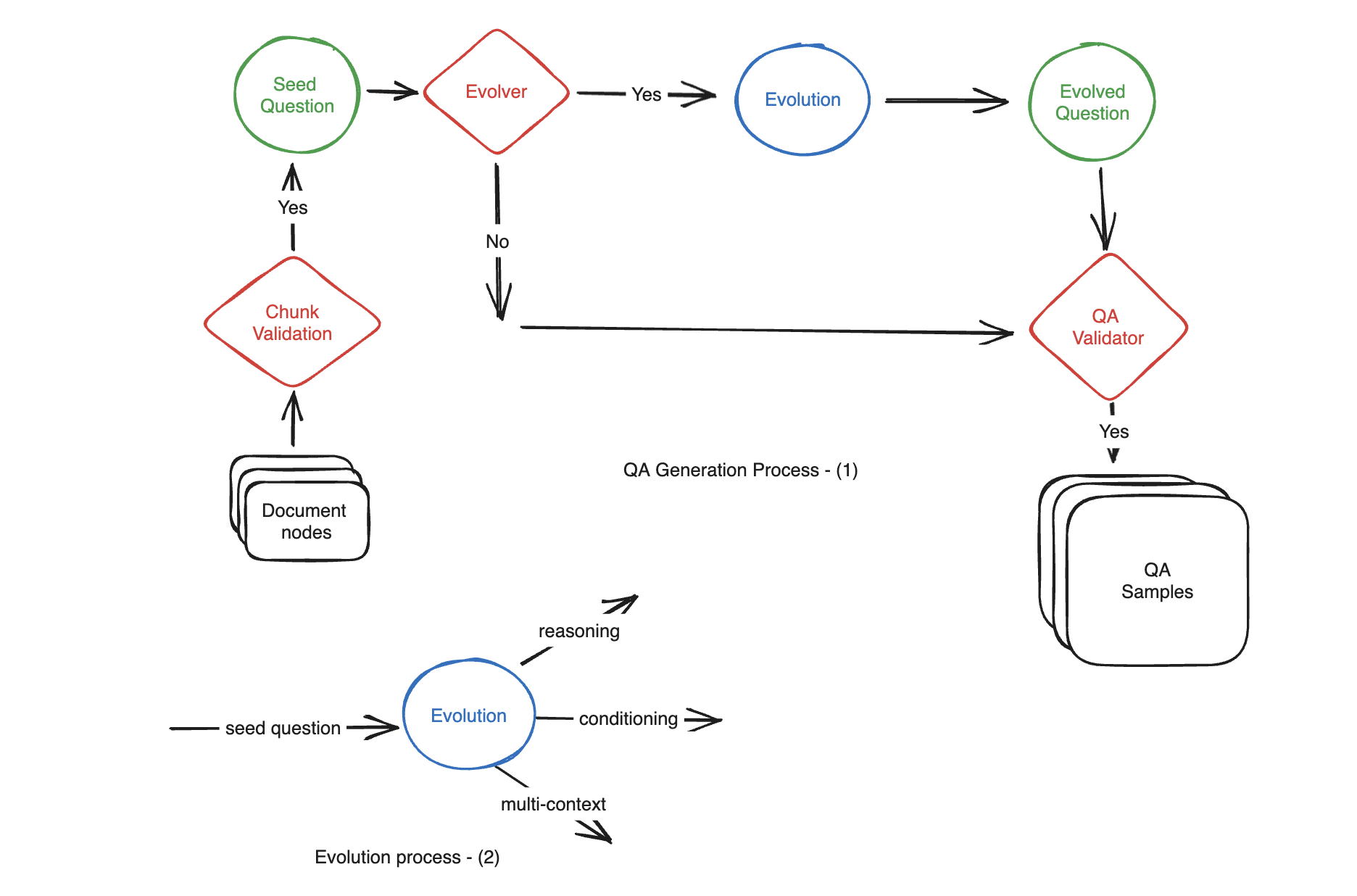
위 3가지 모듈을 이용하여 사전에 로딩한 말뭉치를 이용하여 합성 데이터셋을 생성합니다.
이때 In-Depth Evlution 기능을 통해 대규모 언어 모델(LLM)을 이용하여 간단한 질문을 보다 복잡한 질문으로 효과적으로 변환합니다.
제공된 문서에서 중간에서 어려운 샘플을 생성하기 위해 다음과 같은 방법을 사용합니다:
Reasoning(추론): 질문에 효과적으로 답하기 위해 추론의 필요성을 강화하는 방식으로 질문을 다시 작성합니다.
Conditioning(복잡한 조건): 문제에 복잡성을 더하는 조건 요소를 도입하도록 문제를 수정합니다.
Multi-Context(다중 맥락): 답변을 구성하기 위해 여러 관련 섹션 또는 단락의 정보를 필요로 하는 방식으로 질문을 다시 작성합니다.
위 3가지 Evlution 타입을 비율 (0.5:0.25:0.25) 샘플링하여 합성 데이터셋을 생성합니다.
from ragas.testset.generator import TestsetGenerator
from ragas.testset.evolutions import simple, reasoning, multi_context
from langchain_openai import ChatOpenAI, OpenAIEmbeddings

# generator with openai models
generator_llm = ChatOpenAI(model="gpt-3.5-turbo-16k")
critic_llm = ChatOpenAI(model="gpt-4")
embeddings = OpenAIEmbeddings()

generator = TestsetGenerator.from_langchain(
    generator_llm,
    critic_llm,
    embeddings
)

# generate testset
testset = generator.generate_with_langchain_docs(documents, test_size=10, distributions={simple: 0.5, reasoning: 0.25, multi_context: 0.25})
Generating: 100%|██████████| 10/10 [05:02<00:00, 30.28s/it] test_df = testset.to_pandas()
test_questions = test_df["question"].values.tolist()
test_groundtruths = test_df["ground_truth"].values.tolist()
testset.to_pandas().dataframe tbody tr th {
vertical-align: top;
}
.dataframe thead th {
text-align: right;
}question | contexts | ground_truth | evolution_type | metadata | episode_done | |
|---|---|---|---|---|---|---|
0 | What is the purpose of the Langgraph library i... | [ the old and legacy code to make langchain sl... | The purpose of the Langgraph library in LangCh... | simple | [{'source': 'https://blog.langchain.dev/langch... | True |
1 | How has LangChain implemented composability wi... | [ own package, we can more strictly version th... | LangChain has implemented composability with t... | simple | [{'source': 'https://blog.langchain.dev/langch... | True |
2 | What is the main focus of the LangChain v0.1.0... | [ the old and legacy code to make langchain sl... | The main focus of the LangChain v0.1.0 release... | simple | [{'source': 'https://blog.langchain.dev/langch... | True |
3 | What are some advanced methods for data retrie... | [ own package, we can more strictly version th... | nan | simple | [{'source': 'https://blog.langchain.dev/langch... | True |
4 | What changes have been made to improve the rob... | [\n\n\nLangChain v0.1.0\n\n\n\n\n\n\n\n\n\n\n\... | The third party integrations in LangChain have... | simple | [{'source': 'https://blog.langchain.dev/langch... | True |
5 | What is the main focus of the LangChain v0.1.0... | [ the old and legacy code to make langchain sl... | The main focus of the LangChain v0.1.0 release... | reasoning | [{'source': 'https://blog.langchain.dev/langch... | True |
6 | What challenges did the old LangChain versioni... | [\n\n\nLangChain v0.1.0\n\n\n\n\n\n\n\n\n\n\n\... | The old LangChain versioning policy, which had... | reasoning | [{'source': 'https://blog.langchain.dev/langch... | True |
7 | What changes were made in the LangChain v0.1.0... | [\n\n\nLangChain v0.1.0\n\n\n\n\n\n\n\n\n\n\n\... | The LangChain v0.1.0 release made two large ar... | multi_context | [{'source': 'https://blog.langchain.dev/langch... | True |
8 | How does LangSmith contribute to LLM observabi... | [ own package, we can more strictly version th... | One of the main value props that LangSmith pro... | multi_context | [{'source': 'https://blog.langchain.dev/langch... | True |
9 | What are the core areas of focus in LangChain ... | [\n\n\nLangChain v0.1.0\n\n\n\n\n\n\n\n\n\n\n\... | The core areas of focus in LangChain v0.1.0 ar... | multi_context | [{'source': 'https://blog.langchain.dev/langch... | True |
Create Response using RAG Chain
Ragas를 통해 자동 생성한 합성 데이터셋의 Question 에 대한 Answer 값을 RAG Chain을 통해 생성하여 최종적으로 응답 데이터셋(response_dataset) 생성합니다.
따라서 Base Line(Naive) RAG 파이프라인으로 생성된 응답 값이 ground_truth 와 비교 검증하여 Ragas 평가를 진행합니다.
response_dataset
question
answer
contexts
ground_truth
from datasets import Dataset

answers = []
contexts = []

for question in test_questions:
  response = rag_chain.invoke({"question": question})
  answers.append(response['answer'])
  contexts.append([context.page_content for context in response['source_docs']])

response_dataset = Dataset.from_dict({
    "question" : test_questions,
    "answer" : answers,
    "contexts" : contexts,
    "ground_truth" : test_groundtruths
})

response_dataset.to_pandas()
.dataframe tbody tr th {
vertical-align: top;
}
.dataframe thead th {
text-align: right;
}question | answer | contexts | ground_truth | |
|---|---|---|---|---|
0 | What is the purpose of the Langgraph library i... | The purpose of the Langgraph library in LangCh... | [some from other industry solutions (like Mult... | The purpose of the Langgraph library in LangCh... |
1 | How has LangChain implemented composability wi... | LangChain has implemented composability with t... | [a lot in scalability so that we can release a... | LangChain has implemented composability with t... |
2 | What is the main focus of the LangChain v0.1.0... | The main focus of the LangChain v0.1.0 release... | [Today we’re excited to announce the release o... | The main focus of the LangChain v0.1.0 release... |
3 | What are some advanced methods for data retrie... | Some advanced methods for data retrieval in La... | [some from other industry solutions (like Mult... | nan |
4 | What changes have been made to improve the rob... | To improve the robustness, stability, scalabil... | [any stack. We have almost 700 integrations, r... | The third party integrations in LangChain have... |
5 | What is the main focus of the LangChain v0.1.0... | The main focus of the LangChain v0.1.0 release... | [Today we’re excited to announce the release o... | The main focus of the LangChain v0.1.0 release... |
6 | What challenges did the old LangChain versioni... | The challenges of the old LangChain versioning... | [versioning policy for a little over a month n... | The old LangChain versioning policy, which had... |
7 | What changes were made in the LangChain v0.1.0... | In the LangChain v0.1.0 release, significant c... | [Today we’re excited to announce the release o... | The LangChain v0.1.0 release made two large ar... |
8 | How does LangSmith contribute to LLM observabi... | LangSmith contributes to LLM observability in ... | [changes. These can now be reflected on an ind... | One of the main value props that LangSmith pro... |
9 | What are the core areas of focus in LangChain ... | The core areas of focus in LangChain v0.1.0 ar... | [Today we’re excited to announce the release o... | The core areas of focus in LangChain v0.1.0 ar... |
Evaluate Using Your Test Set
평가 실행은 선택한 메트릭을 사용하여 데이터 세트에서 평가하기를 호출하는 것만큼 간단합니다.
우리가 사용하는 평가 메트릭은 다음과 같습니다.
Metric
faithfulness: 이는 주어진 context(문맥)에 대해 생성된 답변의 사실적 일관성을 측정합니다.
답변과 검색된 문맥에서 계산됩니다. 답변은 (0,1) 범위로 스케일링됩니다. 높을수록 좋습니다.
answer_relevancy: 평가 지표인 답변 관련성은 생성된 답변이 주어진 프롬프트와 얼마나 관련성이 있는지를 평가 하는 데 중점을 둡니다.
불완전하거나 중복된 정보를 포함하는 답변에는 낮은 점수가 부여되며, 점수가 높을수록 관련성이 높음을 나타냅니다.
이 메트릭은 question, context, answer을 사용하여 계산됩니다.
context_recall: context_recall은 retrievedc context가 RAG Chain을 통해 생성된 Answer(ground truth 취급)와 일치하는 정도를 측정합니다.
이 값은 ground truth, retrieved context 기반으로 계산되며, 값은 0과 1 사이의 범위로, 값이 클수록 더 나은 성능을 나타냅니다.
context_precision: context_precision는 컨텍스트에 존재하는 모든 근거 기반 관련 항목의 순위가 높은지 여부를 평가하는 측정지표입니다.
이상적으로는 모든 관련 청크가 상위 순위에 표시되어야 합니다.
이 메트릭은 question, ground_truth 및 context를 사용하여 0에서 1 사이의 값으로 계산되며, 점수가 높을수록 정확도가 높다는 것을 나타냅니다.
answer_correctness: answer_correctness 평가에는 생성된 answer 값이 ground truth와 비교했을 때 얼마나 정확한지 측정하는 작업이 포함됩니다.
이 평가는 ground truth, answer에 따라 0~1점 범위의 점수로 이루어집니다.
점수가 높을수록 생성된 답안과 기준 진실이 더 가깝게 일치하는 것으로, 정답률이 높다는 것을 의미합니다.
from ragas import evaluate

from ragas.metrics import (
    faithfulness,
    answer_relevancy,
    answer_correctness,
    context_recall,
    context_precision,
)

metrics = [
    faithfulness,
    answer_relevancy,
    context_recall,
    context_precision,
    answer_correctness,
]

results = evaluate(response_dataset, metrics, raise_exceptions=False)

results
평가 결과값이 confidence value 값으로 확인 가능합니다.
Evaluating: 100%|██████████| 50/50 [00:20<00:00,  2.50it/s]
{'faithfulness': 1.0000, 'answer_relevancy': 0.9790, 'context_recall': 1.0000, 'context_precision': 0.8444, 'answer_correctness': 0.6330}sysmoon 님의 최신 블로그
더보기-
- 멀티모달 기반 AI 챗봇 기술 연구&개발 (6회차, Dify & Morphik MCP 연동테스트 방법)
- 소개 DEVOCEAN OpenLab 2025 프로젝트의 일환으로 진행된 '멀티모달 기반 AI 챗봇 기술 연구 및 개발' 중 Dify와 Morphik MCP(Model Context Protocol) 연동 테스트 결과를 자세히 공유합니다 [i]. 이 글은 MCP가 무엇인지부터 실제 연동 과정에서 발생한 기술적 문제, 그리고 성능 분석을 통해 얻은 향후 개선 방향을 소개합니다. 세미나 발표자료 파일 첨부하여 드립니다. (Dify & Morphik MCP 연동테스트 결과) 1. AI와 외부 도구 연결의 핵심: MCP(Model Context Protocol)란? AI 모델이 단순히 질문에 답하는 것을 넘어 외부 서비스나 도구를 활용하려면 표준화된 통신 방식이 필요합니다...
-

- 멀티모달 기반 AI 챗봇 기술 연구&개발 (5회차, Agno로 에이전트 구축하기)
- 안녕하세요! 이번 포스팅에서는 에이전트 오케스트레이션(Agent orchestration)에 특화된 Agent 프레임워크 Agno에 대해 소개합니다. Agent Framework TOP 5 에 속하지는 않지만, Agno 의 발전속도와 미래를 보면 LangGraph 와 같이 사용할 경우 큰 시너지를 낼 수 있다고 생각합니다. 각자의 상황에 맞게 전략적으로 활용해보시면 좋을 것 같습니다. 첨언하면 아시는 분은 아시겠지만 Agno 는 Phidata 프로젝트에서 시작해서 Agno 로 새롭게 브랜딩 된 프로젝트 입니다. Phidata 를 유심히 지켜보신 분들은 아마 Agno 의 멀티에이전트 철학에 대해 이해하고 쉽게 접근하실 수 있을 것입니다. Agno (Agent Fra...
-
- 멀티모달 기반 AI 챗봇 기술 연구&개발 (4회차, VLM(ColPali) & MUVERA 기술 소개)
- 오늘은 Morphik(Multimodal Agent Framework) 에 대해 소개하고, 이 기술의 핵심인 VLM 을 이용하여 문서 청킹/파싱 과정 없이 시각적으로 맥락을 이해하기 위한 ColPali 와 멀티벡터를 빠르게 인덱싱&검색하기 위한 MUVERA 기술에 대해 소개합니다. Morphik의 핵심 기술 심층 분석 (ColPali & MUVERA) Morphik은 복잡한 문서(PDF, 이미지)를 정확하고 빠르게 검색하기 위해 설계된 멀티모달 프레임워크이며, 특히 전통적인 RAG 시스템의 한계였던 시각 정보 처리 및 멀티 벡터 검색 속도 문제를 해결하는 데 중점을 둡니다. 1. ColPali: 시각적 맥락을 이해하는 멀티모달 검색 엔진 ColPali는 ColBE...
-
- Morphik - 멀티모달티를 위한 ColPali와 MUVERA 기술에 대하여
- 목차 서론 ColPali MUVERA 1. 서론 지난글애서는 Morphik - 멀티모달티를 위한 RAG에서 문서 파싱 없이 이미지를 사용하는 방법 에 대해서 소개했고, 오늘은 이어서 Morphik 을 이용한 멀티 모달 기반 문서 검색 시스템의 핵심 기술인 ColPali & MUVERA & Late Interaction 개념에 대해 자세히 소개합니다. 우리가 흔히 사용하는 텍스트 추출 기반 RAG는 꽤 똑똑하지만, 현실에서는 몇 가지 아쉬움이 있습니다. PDF를 파싱하거나 OCR, 캡처링을 거치면서 중요한 정보가 사라지거나 오류가 생기기 쉽습니다. 문서를 제대로 다루려면 복잡한 전처리 과정이 필요하고, 시간과 비용이 상당히 소요됩니다. 결국, 단순 텍스트만 활용하는...
DEVOTEE 추천 블로그
-
- LangChain LCEL과 RAGAS를 사용한 Native RAG 평가
- LangChain LCEL을 사용해서 Native RAG를 구현하고 RAGAS library를 사용해 평가를 진행해보겠습니다. 최근에 LangChain에 추가된 LCEL과 새로운 package 구조도 체험해보고, RAG 평가를 손쉽게 도와주는 RAGAS도 한번에 확인해보려고 합니다. 코드 예제는 Nayak님의 Medium 글을 참고하면서, 최신 LangChain 버전에 맞게 코드를 일부 업데이트 하였습니다. Azure LLM 과 Embedding 초기화 import os from langchain_openai import AzureChatOpenAI from langchain_openai import AzureOpenAIEmbeddings embeddings = ...
-

- OpenLab - LLMOps : AutoRAG, DATA CREATION
- 안녕하세요, LLMOps 스터디에 참여중인 이지현입니다! 😊 저는 AutoRAG라는 소주제를 선택했는데요, 본격적인 첫 스터디의 주제는 [DATA CREATION]입니다! 오늘은 첫 시간이기 때문에 RAG와 AutoRAG에 대한 간단한 설명부터 시작하겠습니다 ~ RAG란? RAG(Retrieval-Augmented Generation)는 정보 검색(IR)과 자연어 생성(NLG) 모델을 결합하여 AI가 더 정확하고 상세한 정보를 제공할 수 있도록 하는 기술입니다. RAG는 두 가지 주요 구성 요소로 이루어집니다. 문서 검색기(Retriever): 대규모 데이터베이스나 문서 집합에서 사용자 질문과 관련된 정보를 검색합니다. 대규모 언어 모델(LLM): 검색된 정보를...
-
- OpenLab - LLMOps, RAGAS LLM 평가지표 (Faithfulness)
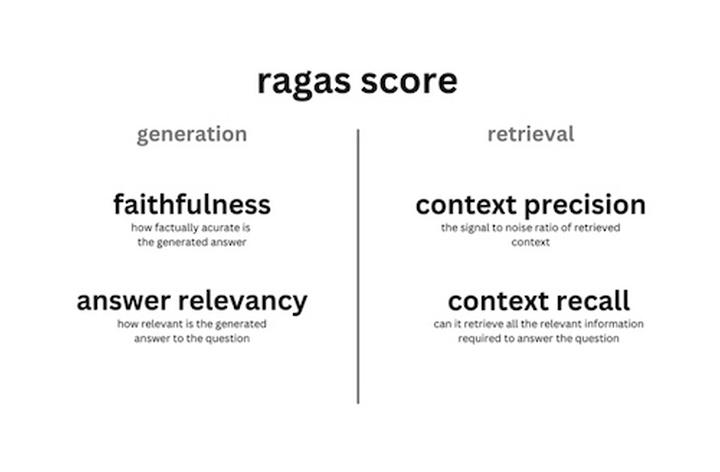
- RAGAS 는 LLM 평가를 위한 데이터셋을 생성하고, 이를 평가하기 위한 LLM Evaluation 프레임워크 입니다. 주요 평가 지표 항목으로 아래 그림 (ragas score)과 같이 생성 (generation), 데이터 획득 (retriever) 을 제공합니다. Component-Wise Evaluation 다른 머신 러닝 시스템과 마찬가지로 LLM 및 RAG 파이프라인 내의 개별 구성 요소의 성능은 전체 경험에 큰 영향을 미칩니다. Ragas는 RAG 파이프라인의 각 구성 요소를 개별적으로 평가하기 위한 맞춤형 메트릭을 제공합니다. Ragas 주요 성능 메트릭을 살펴보면 크게 Retrieval, Generation 각 카테고리 별 측면에서 메트릭을 정의할...
-

- RAG 파이프라인과 사고의 사슬(CoT) 프롬프팅을 활용한 최종 답변 출력 예시
- 환경 변수 로드: load_dotenv() 함수를 사용하여 .env 파일에 저장된 설정값을 호출 LLM 초기화: ChatOpenAI 클래스를 이용해 OpenAI의 챗 모델을 초기화temperature=0.0으로 지정하여 일관된 답변을 얻도록 함. 가짜 Retriever 정의: RAG 기법(Retrieval-Augmented Generation, 검색 증강 생성)에서 retriever는 질문과 관련된 문서를 검색해 주는 역할을 합니다. 이 예제에서는 간단히 미리 준비된 docs 딕셔너리에 세 개의 문서를 담아 두고, fake_retriever 함수를 통해 항상 상위 3개 문서를 반환하도록 하였습니다. 실제로는 검색 엔진이나 벡터 DB를 활용합니다. 최종 답변 파서 ...

DEVOTEE를 활성화 시키면
지금 작성한 댓글에 AI가 댓글을 달아줍니다.